Blog

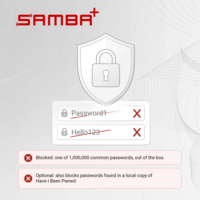
SAMBA+ now includes a Password Blacklist Check. Before a domain controller accepts a new password, it compares it against lists of known-weak and breached passwords, and optionally against a local copy of the Have I Been Pwned database. The check is included in the current packages from SAMBA+ 4.23 onwards and is part of every SAMBA+ subscription.

The complexity rules of Active Directory let Password1 through. Hello123 too. Those are among the first passwords an attacker tries, and the first ones a penetration test looks for. Some organizations try to catch such passwords in a self-service portal. That covers only the changes made through the portal; anyone who changes a password on a Windows client or with administration tools bypasses it. The Password Blacklist Check runs on the domain controller, which processes every password change, whichever way it comes in. It is the blocklist check that NIST SP 800-63B-4 requires for every new or changed password. For organizations that have dropped the 90-day password change, as NIST and the BSI recommend, this check keeps weak and breached passwords out from the start. Together with the default complexity rules, the bundled list blocks the one million most commonly used passwords; administrators can add their own, from company names to the local football club.

For a broader check, SAMBA+ compares passwords against the Have I Been Pwned collection (passwords from publicly known breaches). The lookup runs locally on the domain controller. No password and no hash leaves the server. On Windows domains, Microsoft offers banned-password checks only as part of its cloud: Entra Password Protection requires an Entra tenant with P1 or P2 licensing, a forest registered with that tenant and a proxy server with internet access to Microsoft. SAMBA+ needs none of these; the check is part of the package.

Developed and maintained by SerNet

The Password Blacklist Check was developed at SerNet for SAMBA+ and arrives with the regular package updates, for vendors who build their products on SAMBA+ as well. The subscriptions for SAMBA+ fund the ongoing development work for Samba at SerNet, and with it the development on upstream Samba.

Availability

The check is available for SAMBA+ in the AD domain controller role, on Linux. How to enable it, add custom lists and set up the local Have I Been Pwned copy is described in the HowTo: Harden SAMBA+.

Questions about the Password Blacklist Check, help with the rollout, an audit requirement to meet, or a product built on SAMBA+? SerNet supports you through support budgets and service level agreements. Write to sales@remove-this.samba.plus or use our contact form.


SAMBA+ 4.25.1 has been released by SerNet and is now available for SUSE and Red Hat platforms, Debian GNU/Linux, Ubuntu, and AIX. It is the latest stable release of the Samba 4.25 series.

Samba 4.25.1 fixes CVE-2026-109411, an access control bypass in the vfs_ceph_rgw module caused by case-insensitive open handling. The module was introduced with Samba 4.25.0, so only installations running that version with vfs_ceph_rgw enabled are affected. If you run vfs_ceph_rgw, update as soon as possible.

Beyond that, this release addresses several issues reported since Samba 4.25.0, including CTDB cluster handling, dynamic interfaces in smbd, case-only renames, and a crash in vfs_acl_xattr. All fixes are documented in the official release notes:

As usual, the new packages are included in existing SAMBA+ subscriptions and can be obtained via the SAMBA+ shops:

If you have questions, need help with an upgrade, or would like a quote, contact the SAMBA+ team at SerNet.


SerNet has released SAMBA+ 4.25.0 for SUSE and Red Hat platforms, as well as for Debian GNU/Linux, Ubuntu and AIX.

This is the first stable SAMBA+ release of the new 4.25 release series. Please read the release notes carefully before upgrading.

Experimental support for SMB3 Persistent Handles marks the highlight of this release – developed at SerNet and contributed upstream to Samba. Persistent Handles allow SMB clients to reconnect after a server restart or outage while retaining valid file handles. This is a fundamental building block for SMB Transparent Failover, helping applications maintain uninterrupted access to files across server failures. Typical use cases include virtual machine storage and clustered databases.

Transparent Failover and Persistent Handles complete one milestone of the Samba development project funded by Germany's Sovereign Tech Agency (more on the STF project).

Ceph, clustering and CTDB

The new ceph_rgw vfs module is currently available for Debian 13 (Trixie) and Ubuntu 26.04 LTS (Resolute). It exports Ceph Object Gateway buckets as SMB shares with a hierarchical view of the stored objects. Vinit Agnihotri (IBM) presented the module at sambaXP 2026.

Other new features concerning clustered setups:

  • Cluster-wide rate limiting in vfs_aio_ratelimit enforces the configured per-share limits as a global ceiling across the cluster instead of per node.
  • CTDB Locks, PID files and sockets now use ctdb/ subdirectories of the Samba locations.
  • Monitoring of network infrastructure such as DNS or AD servers is now supported. Warnings are logged when infrastructure has been missing or failing beyond configured thresholds, which makes root cause analysis after unexplained timeouts considerably easier.

Looking ahead, Samba now maintains a cluster functional level, a cluster-wide value that gates changes affecting the communication between nodes. This prepares rolling upgrades under certain conditions in future versions. It does not apply to upgrades with 4.25 as the target.

A full overview of all changes and enhancements is available in the Samba release notes:

Instructions for package access and upgrading are available in the SAMBA+ How-to collection.

Release series lifecycle

SAMBA+ packages are built by the Samba developers at SerNet from a single source package, maintained across the supported release series and backed by commercial support. They ship Samba's full feature set, including the AD domain controller and clustering support built in. More reasons to use SAMBA+.

With the new 4.25 release Samba 4.24 has been turned into the "maintenance mode" and Samba 4.23 into the "security fixes only mode". Samba 4.22 will probably not receive any updates beyond this point. The SAMBA+ 4.22 repositories will be disabled soon. Please update to a more recent version of SAMBA+.

SAMBA+ packages are delivered under a subscription model and are available in the SAMBA+ shop:

If you already have an active subscription, the new 4.25.0 packages are included. For questions about licensing, procurement, or help with the update, contact the SAMBA+ team at SerNet.

SAMBA+ 4.24.8 has been released by SerNet and is now available for SUSE and Red Hat platforms, Debian GNU/Linux, Ubuntu, and AIX. It is the latest stable release of the Samba 4.24 series.

This release addresses several issues reported since Samba 4.24.7, including SMB3 session setup signing, renames with ReplaceIfExists where the target differs only in case, winbindd stability with more than one domain connection, and parsing of uppercase hex values in the kdc default domain supported enctypes parameter. All fixes are documented in the official release notes:

If you are upgrading from a SAMBA+ version older than 4.21 and use your own or third-party scripts that rely on Samba's Python modules, you must install the sernet-samba-python3 package after upgrading on Debian or Ubuntu systems. RHEL and SUSE-based systems are not affected.

As usual, the new packages are included in existing SAMBA+ subscriptions and can be obtained via the SAMBA+ shops:

If you have questions, need help with an upgrade, or would like a quote, contact the SAMBA+ team at SerNet.


SAMBA+ 4.23.13 has been released by SerNet and is now available for SUSE and Red Hat platforms, Debian GNU/Linux, Ubuntu, and AIX. It is the latest stable release of the Samba 4.23 series.

This release addresses several issues reported since Samba 4.23.12, including winbindd stability and CTDB database handling. All fixes are documented in the official release notes:

If you are upgrading from a SAMBA+ version older than 4.21 and use your own or third-party scripts that rely on Samba's Python modules, you must install the sernet-samba-python3 package after upgrading on Debian or Ubuntu systems. RHEL and SUSE-based systems are not affected.

As usual, the new packages are included in existing SAMBA+ subscriptions and can be obtained via the SAMBA+ shops:

If you have questions, need help with an upgrade, or would like a quote, contact the SAMBA+ team at SerNet.


Contact us
Contact
Deutsch English Français